
The Puzzle of Dickens's Last Plot, by Andrew Lang
Transcribed from the 1905 Chapman and educational space playsets for 8 year oldsHall edition by DavidPrice, email [email protected]
THE PUZZLE OF
DICKENS’S LAST PLOT
BY
ANDREW LANG
LONDON
CHAPMAN & HALL, LD.
1905
p.viINTRODUCTION
Forster tells us that Dickens, inhis later novels, from Bleak Houseonwards (1853),“assiduously cultivated” construction, “thisessential of his art.” Some critics may think, thatsince so many of the best novels in the world “have nooutline, or, if they have an outline, it is a demnedoutline,” elaborate construction is not absolutely“essential.” Really essential are character,“atmosphere,” humour.
But as, in the natural changes of life, and under the strainof restless and unsatisfied activity, his old buoyancy andunequalled high spirits deserted Dickens, he certainly wrote nolonger in what Scott, speaking of himself, calls the manner of“hab nab at a venture.” He constructedelaborate plots, rich in secrets and surprises. He emulatedthe manner of Wilkie Collins, or even of Gaboriau, while hecombined with some of the elements of the detective novel, orroman policier, careful study of character. ExceptGreat Expectations, none of his later tales rivals inmerit his early picaresque stories of the road, such asPickwickand Nicholas Nickleby. “Youthwill be served;” no sedulous care could compensate for theexuberance of “the first sprightly runnings.” In the early books the melodrama of the plot, the secrets ofRalph Nickleby, of Monk, of Jonas Chuzzlewit, were the least ofthe innumerable attractions. But Dickens was more and moredrawn towards the secret that excites curiosity, and to the gameof hide and seek with the reader who tried to anticipate thesolution of the secret.
In April, 1869, Dickens, outworn by the strain of his Americanreadings; of that labour achieved under painful conditions ofominously bad health—found himself, as Sir Thomas Watsonreported, “on the brink of an attack of paralysis of hisleft side, and possibly of apoplexy.” He thereforeabandoned a new series of Readings. We think ofScott’s earlier seizures of a similar kind, after whichPeveril, he said, “smacked of theapoplexy.” But Dickens’s new story of TheMystery of Edwin Drood, first contemplated in July, 1869, andaltered in character by the emergence of “a very curiousand new idea,” early in August, does not “smack ofthe apoplexy.” We may think that the mannerisms ofMr. Honeythunder, the philanthropist, and of Miss Twinkleton, theschoolmistress, are not in the author’s best vein ofhumour. “The Billickin,” on the other hand, thelodging-house keeper, is “in very gracious fooling:”her unlooked-for sallies in skirmishes with Miss Twinkleton arerich in mirthful surprises. Mr. Grewgious may becaricatured too much, but not out of reason; and Dickens, alwaysgood at boys, presents a gamin, in Deputy, who is in notunpleasant contrast with the pathetic Jo of BleakHouse. Opinions may differ as to Edwin and Rosa, butthe more closely one studies Edwin, the better one thinks of thatcharacter. As far as we are allowed to see Helena Landless,the restraint which she puts on her “tigerish blood”is admirable: she is very fresh and original. The villainis all that melodrama can desire, but what we do miss, I think,is the “atmosphere” of a small cathedral town. Here there is a lack of softness and delicacy of treatment: onthe other hand, the opium den is studied from the life.
On the whole, Dickens himself was perhaps most interested inhis plot, his secret, his surprises, his game of hide and seekwith the reader. He threw himself into the sport with zest:he spoke to his sister-in-law, Miss Hogarth, about his fear thathe had not sufficiently concealed his tracks in the latestnumbers. Yet, when he died in June, 1870, leaving threecompleted numbers still unpublished, he left his secret as apuzzle to the curious. Many efforts have been made todecipher his purpose, especially his intentions as to thehero. Was Edwin Drood killed, or did he escape?
By a coincidence, in September, 1869, Dickens was working overthe late Lord Lytton’s tale for All The Year Round,“The Disappearance of John Ackland,” for the purposeof mystifying the reader as to whether Ackland was alive ordead. But he was conspicuously defunct! (All theYear Round, September-October, 1869.)
The most careful of the attempts at a reply about Edwin, astudy based on deep knowledge of Dickens, is “Watched bythe Dead,” by the late ingenious Mr. R. A. Proctor(1887). This book, to which I owe much aid, is now out ofprint. In 1905, Mr. Cuming Walters revived “the auldmysterie,” in his “Clues to Dickens’s EdwinDrood” (Chapman & Hall and Heywood, Manchester). From the solution of Mr. Walters I am obliged to dissent. Of Mr. Proctor’s theory I offer some necessary corrections,and I hope that I have unravelled some skeins which Mr. Proctorleft in a state of tangle. As one read and re-read thefragment, points very dark seemed, at least, to become suddenlyclear: especially one appeared to understand the meaninghalf-revealed and half-concealed by Jasper’s babblingsunder the influence of opium. He saw in his vision,“that, I never saw thatbefore.” We may be sure that he was to see “that” inreal life. We must remember that, according to Forster,“such was Dickens’s interest in things supernaturalthat, but for the strong restraining power of his common sense,he might have fallen into the follies ofspiritualism.” His interest in such matters certainlypeeps out in this novel—there are two specimens of thesupernormal—and he may have gone to the limited extentwhich my hypothesis requires. If I am right, Dickens wentfurther, and fared worse, in the too material premonitions of“The Signalman” in Mugby Junction.
With this brief preface, I proceed to the analysis ofDickens’s last plot. Mr. William Archer has kindlyread the proof sheets and made valuable suggestions, but isresponsible for none of my theories.
ANDREW LANG.
St. Andrews,
September4,1905.
p. 1THESTORY
Dramatis Personæ
For the discovery ofDickens’s secret in Edwin Droodit is necessary toobtain a clear view of the characters in the tale, and of theirrelations to each other.
About the middle of the nineteenth century there lived inCloisterham, a cathedral city sketched from Rochester, a youngUniversity man, Mr. Bud, who had a friend Mr. Drood, one of afirm of engineers—somewhere. They were “fastfriends and old college companions.” Both marriedyoung. Mr. Bud wedded a lady unnamed, by whom he was thefather of one child, a daughter, Rosa Bud. Mr. Drood, whosewife’s maiden name was Jasper, had one son, EdwinDrood. Mrs. Bud was drowned in a boating accident, when herdaughter, Rosa, was a child. Mr. Drood, already a widower,and the bereaved Mr. Bud “betrothed” the twochildren, Rosa and Edwin, and then expired, when the orphans wereabout seven and eleven years old. The guardian of Rosa wasa lawyer, Mr. Grewgious, who had been in love with hermother. To Grewgious Mr. Bud entrusted his wife’sengagement ring, rubies and diamonds, which Grewgious was to handover to Edwin Drood, if, when he attained his majority, he andRosa decided to marry.
Grewgious was apparently legal agent for Edwin, whileEdwin’s maternal uncle, John Jasper (aged about sixteenwhen the male parents died), was Edwin’s“trustee,” as well as his uncle and devotedfriend. Rosa’s little fortune was an annuityproducing £250 a-year: Edwin succeeded to hisfather’s share in an engineering firm.
When the story opens, Edwin is nearly twenty-one, and is aboutto proceed to Egypt, as an engineer. Rosa, at school inCloisterham, is about seventeen; John Jasper is twenty-six. He is conductor of the Choir of the Cathedral, a “layprecentor;” he is very dark, with thick black whiskers,and, for a number of years, has been a victim to the habit ofopium smoking. He began very early. He takes thisdrug both in his lodgings, over the gate of the Cathedral, and ina den in East London, kept by a woman nicknamed “ThePrincess Puffer.” This hag, we learn, has been adetermined drunkard,—“I drankheaven’s-hard,”—for sixteen years beforeshe took to opium. If she has been dealing in opium for tenyears (the exact period is not stated), she has been verydisreputable for twenty-six years, that is ever since JohnJasper’s birth. Mr. Cuming Walters suggests that sheis the mother of John Jasper, and, therefore, maternalgrandmother of Edwin Drood. She detests her client, Jasper,and plays the spy on his movements, for reasons unexplained.
Jasper is secretly in love with Rosa, thefiancéeof his nephew, and his own pupil in themusical art. He makes her aware of his passion, silently,and she fears and detests him, but keeps these emotionsprivate. She is a saucy school-girl, and she and Edwin areon uncomfortable terms: she does not love him, while he perhapsdoes love her, but is annoyed by her manner, and by the gossipabout their betrothal. “The bloom is off theplum” of their prearranged loves, he says to his friend,uncle, and confidant, Jasper, whose own concealed passion forRosa is of a ferocious and homicidal character. Rosa isaware of this fact; “a glaze comes over his eyes,”sometimes, she says, “and he seems to wander away into afrightful sort of dream, in which he threatens most . . .” The man appears to have these frightful dreams evenwhen he is not under opium.
Opening of the Tale
The tale opens abruptly with an opium-bred vision of the towerof Cloisterham Cathedral, beheld by Jasper as he awakens in theden of the Princess Puffer, between a Chinaman, a Lascar, and thehag herself. This Cathedral tower, thus early andemphatically introduced, is to play a great but more or lessmysterious part in the romance: that is certain. Jasper,waking, makes experiments on the talk of the old woman, theLascar and Chinaman in their sleep. He pronounces it“unintelligible,” which satisfies him that his ownbabble, when under opium, must be unintelligible also. Heis, presumably, acquainted with the languages of the easterncoast of India, and with Chinese, otherwise, how could he hope tounderstand the sleepers? He is being watched by the hag,who hates him.
Jasper returns to Cloisterham, where we are introduced to theDean, a nonentity, and to Minor Canon Crisparkle, a muscularChristian in the pink of training, a classical scholar, and agood honest fellow. Jasper gives Edwin a dinner, and gushesover “his bright boy,” a lively lad, full of chaff,but also full of confiding affection and tenderness ofheart. Edwin admits that his betrothal is a bore: Jasperadmits that he loathes his life; and that the church singing“often sounds to me quite devilish,”—and nowonder. After this dinner, Jasper has a “weirdseizure;” “a strange film comes over Jasper’seyes,” he “looks frightfully ill,” becomesrigid, and admits that he “has been taking opium for apain, an agony that sometimes overcomes me.” This“agony,” we learn, is the pain of hearing Edwin speaklightly of his love, whom Jasper so furiously desires. “Take it as a warning,” Jasper says, but Edwin,puzzled, and full of confiding tenderness, does notunderstand.
In the next scene we meet the school-girl, Rosa, who takes awalk and has a tiff with Edwin. Sir Luke Fildes’sillustration shows Edwin as “a lad with the bloom of alass,” with a classic profile; and a gracioushead of long, thick, fair hair, long, though welearn it has just been cut. He wears a soft slouched hat,and the pea-coat of the period.
Sapsea and Durdles
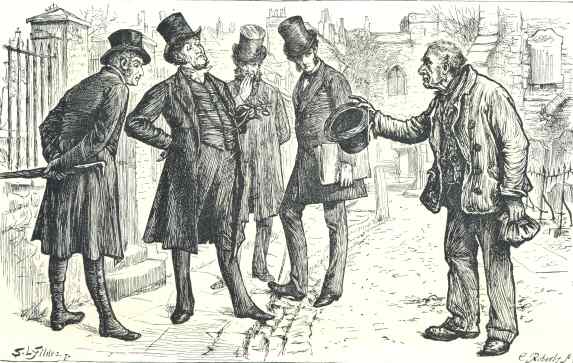
Next, Jasper and Sapsea, a pompous ass, auctioneer, and mayor,sit at their wine, expecting a third guest. Mr. Sapseareads his absurd epitaph for his late wife, who is buried in a“Monument,” a vault of some sort in the Cathedralchurchyard. To them enter Durdles, a man never sober, yettrusted with the key of the crypt, “as contractor for roughrepairs.” In the crypt “he habitually sleepsoff the fumes of liquor.” Of course no Dean wouldentrust keys to this incredibly dissipated, dirty, and insolentcreature, to whom Sapsea gives the key of his vault, for noreason at all, as the epitaph, of course, is to be engraved onthe outside, by Durdles’s men. However, Durdlesinsists on getting the key of the vault: he has two other largekeys. Jasper, trifling with them, keeps clinking themtogether, so as to know, even in the dark, by the sound, which isthe key that opens Sapsea’s vault, in the railed-off burialground, beside the cloister arches. He has met Durdles atSapsea’s for no other purpose than to obtain access at willto Mrs. Sapsea’s monument. Later in the eveningJasper finds Durdles more or less drunk, and being stoned by agamin, “Deputy,” a retainer of a tramp’slodging-house. Durdles fees Deputy, in fact, to drive himhome every night after ten. Jasper and Deputy fall intofeud, and Jasper has thus a new, keen, and omnipresentenemy. As he walks with Durdles that worthy explains (inreply to a question by Jasper), that, by tapping a wall, even ifover six feet thick, with his hammer, he can detect the nature ofthe contents of the vault, “solid in hollow, and insidesolid, hollow again. Old ’un crumbled away in stonecoffin, in vault.” He can also discover the presenceof “rubbish left in that same six foot space byDurdles’s men.” Thus, if a foreign body wereintroduced into the Sapsea vault, Durdles could detect itspresence by tapping the outside wall. As Jasper’spurpose clearly is to introduce a foreign body—that ofEdwin who stands between him and Rosa—into Mrs.Sapsea’s vault, this “gift” of Durdles is, forJasper, an uncomfortable discovery. He goes home, watchesEdwin asleep, and smokes opium.
The Landlesses
Two new characters are now introduced, Neville and HelenaLandless, [11] twins, orphans, of Cingaleseextraction, probably Eurasian; very dark, the girl “almostof the gipsy type;” both are “fierce oflook.” The young man is to read with Canon Crisparkleand live with him; the girl goes to the same school asRosa. The education of both has been utterly neglected;instruction has been denied to them. Neville explains thecause of their fierceness to Crisparkle. In Ceylon theywere bullied by a cruel stepfather and several times ran away:the girl was the leader, always “dressed as a boy,and showing the daring of a man.” EdwinDrood’s air of supercilious ownership of Rosa Bud(indicated as a fault of youth and circumstance, not of heart andcharacter), irritates Neville Landless, who falls in love withRosa at first sight. As Rosa sings, at Crisparkle’s,while Jasper plays the piano, Jasper’s fixed stare producesan hysterical fit in the girl, who is soothed by HelenaLandless. Helena shows her aversion to Jasper, who, as evenEdwin now sees, frightens Rosa. “You would be afraidof him, under similar circumstances, wouldn’t you, MissLandless?” asks Edwin. “Not under anycircumstances,” answers Helena, and Jasper “thanksMiss Landless for this vindication of his character.”
The girls go back to their school, where Rosa explains toHelena her horror of Jasper’s silent love-making: “Ifeel that I am never safe from him . . . a glaze comes over hiseyes and he seems to wander away into a frightful sort of dreamin which he threatens most,” as already quoted. Helena thus, and she alone, except Rosa, understands Jasperthoroughly. She becomes Rosa’s protectress. “Let whomsoever it most concerned look well toit.”
Thus Jasper has a new observer and enemy, in addition to theomnipresent street boy, Deputy, and the detective old hag of theopium den.
Leaving the Canon’s house, Neville and Edwin quarrelviolently over Rosa, in the open air; they are followed byJasper, and taken to his house to be reconciled over glasses ofmulled wine. Jasper drugs the wine, and thus provokes aviolent scene; next day he tells Crisparkle that Neville is“murderous.” “There is something of thetiger in his dark blood.” He spreads the story of thefracasin the town.
Mr. Grewgious
Grewgious, Rosa’s guardian, now comes down on business;the girl fails to explain to him the unsatisfactory relationsbetween her and Edwin: Grewgious is to return to her “atChristmas,” if she sends for him, and she does send. Grewgious, “an angular man,” all duty and sentiment(he had loved Rosa’s mother), has an interview withEdwin’s trustee, Jasper, for whom he has no enthusiasm, butwhom he does not in any way suspect. They part on goodterms, to meet at Christmas. Crisparkle, with whom Helenahas fallen suddenly in love, arranges with Jasper that Edwin andLandless shall meet and be reconciled, as both are willing to be,at a dinner in Jasper’s rooms, on Christmas Eve. Jasper, when Crisparkle proposes this, denotes by his manner“some close internal calculation.” We see thathe is reckoning how the dinner suits his plan of campaign, and“closecalculation” may refer, as in Mr.Proctor’s theory, to the period of the moon: onChristmas Eve there will be no moonshine at midnight. Jasper, having worked out this problem, acceptsCrisparkle’s proposal, and his assurances about Neville,and shows Crisparkle a diary in which he has entered his fearsthat Edwin’s life is in danger from Neville. Edwin(who is not in Cloisterham at this moment) accepts, by letter,the invitation to meet Neville at Jasper’s on ChristmasEve.
Meanwhile Edwin visits Grewgious in his London chambers; islectured on his laggard and supercilious behaviour as a lover,and receives the engagement ring of the late Mrs. Bud,Rosa’s mother, which is very dear to Grewgious—in thepresence of Bazzard, Grewgious’s clerk, a gloomy writer ofan amateur unacted tragedy. Edwin is to return the ring toGrewgious, if he and Rosa decide not to marry. The ring isin a case, and Edwin places it “in his breast.” We must understand, in the breast-pocket of his coat: no otherinterpretation will pass muster. “Her ring—willit come back to me?” reflects the mournful Grewgious.
The Unaccountable Expedition
Jasper now tells Sapsea, and the Dean, that he is to make“a moonlight expedition with Durdles among the tombs,vaults, towers, and ruins to-night.” The impossibleDurdles has the keys necessary for this, “surely anunaccountable expedition,” Dickens keeps remarking. The moon seems to rise on this night at about 7.30 p.m. Jasper takes a big case-bottle of liquor—drugged, of courseand goes to the den of Durdles. In the yard of thisinspector of monuments he is bidden to beware of a mound ofquicklime near the yard gate. “With a little handystirring, quick enough to eat your bones,” saysDurdles. There is some considerable distance between this“mound” of quicklime and the crypt, of which Durdleshas the key, but the intervening space is quite empty of humanpresence, as the citizens are unwilling to meet ghosts.
In the crypt Durdles drinks a good deal of the druggedliquor. “They are to ascend the greatTower,”—and why they do that is part of the Mystery,though not an insoluble part. Before they climb, Durdlestells Jasper that he was drunk and asleep in the crypt, lastChristmas Eve, and was wakened by “the ghost of oneterrific shriek, followed by the ghost of the howl of a dog, along dismal, woeful howl, such as a dog gives when aperson’s dead.” Durdles has made inquiries and,as no one else heard the shriek and the howl, he calls thesesounds “ghosts.”
They are obviously meant to be understood as supranormalpremonitory sounds; of the nature of second sight, or rather ofsecond hearing. Forster gives examples of Dickens’stendency to believe in such premonitions: Dickens had himself acurious premonitory dream. He considerably overdid thepremonitory business in his otherwise excellent story, TheSignalman, or so it seems to a student of these things. The shriek and howl heard by Durdles are to be repeated, we see,in real life, later, on a Christmas Eve. The questionis—when? More probably noton the ChristmasEve just imminent, when Edwin is to vanish, but, on the ChristmasEve following, when Jasper is to be unmasked.
All this while, and later, Jasper examines Durdles veryclosely, studying the effects on him of the drugged drink. When they reach the top of the tower, Jasper closely contemplates“that stillest part of it” (the landscape)“which the Cathedral overshadows; but he contemplatesDurdles quite as curiously.”
There is a motive for the scrutiny in either case. Jasper examines the part of the precincts in the shadow of theCathedral, because he wishes to assure himself that it is lonelyenough for his later undescribed but easily guessed proceedingsin this night of mystery. He will have much to do thatcould not brook witnesses, after the drugged Durdles has fallensound asleep. We have already been assured that the wholearea over which Jasper is to operate is “utterlydeserted,” even when it lies in full moonlight, about 8.30p.m. “One might fancy that the tide of life wasstemmed by Mr. Jasper’s own gate-house.” Thepeople of Cloisterham, we hear, would deny that they believe inghosts; but they give this part of the precinct a wide berth(Chapter XII.). If the region is “utterlydeserted” at nine o’clock in the evening, when itlies in the ivory moonlight, much more will it be free from humanpresence when it lies in shadow, between one and twoo’clock after midnight. Jasper, however, from thetower top closely scrutinizes the area of his futureoperations. It is, probably, for this very purpose ofdiscovering whether the coast be clear or not, that Jasper climbsthe tower.
He watches Durdles for the purpose of finding how the drugwhich he has administered works, with a view to future operationson Edwin. Durdles is now in such a state that “hedeems the ground so far below on a level with the tower, andwould as lief walk off the tower into the air as not.”
All this is apparently meant to suggest that Jasper, onChristmas Eve, will repeat his expedition, with Edwin,whom he will have drugged, and that he will allow Edwin to“walk off the tower into the air.” There arelater suggestions to the same effect, as we shall see, but theyare deliberately misleading. There are also strongsuggestions to the very opposite effect: it is broadly indicatedthat Jasper is to strangle Edwin with a thick black-silk scarf,which he has just taken to wearing for the good of histhroat.
The pair return to the crypt, Durdles falls asleep, dreamsthat Jasper leaves him, “and that something touches him andsomething falls from his hand. Then something clinks andgropes about,” and the lines of moonlight shift theirdirection, as Durdles finds that they have really done when hewakens, with Jasper beside him, while the Cathedral clock strikestwo. They have had many hours, not less than five, fortheir expedition. The key of the crypt lies beside Durdleson the ground. They go out, and as Deputy beginsstone-throwing, Jasper half strangles him.
Purpose of the Expedition
Jasper has had ample time to take models in wax of allDurdles’s keys. But he could have done that in a fewminutes, while Durdles slept, if he had wax with him, withoutleaving the crypt. He has also had time to convey severalwheelbarrowfuls of quicklime from Durdles’s yard to Mrs.Sapsea’s sepulchre, of which monument he probably took thekey from Durdles, and tried its identity by clinking. Buteven in a Cathedral town, even after midnight, several successiveexpeditions of a lay precentor with a wheelbarrow full ofquicklime would have been apt to attract the comment of somebelated physician, some cleric coming from a sick bed, or somelocal roysterers. Therefore it is that Dickens insists onthe “utterly deserted” character of the area, andshows us that Jasper has made sure of that essential fact byobservations from the tower top. Still, his was a perilousexpedition, with his wheelbarrow! We should probably learnlater, that Jasper was detected by the wakeful Deputy, wholoathed him. Moreover, next morning Durdles was apt tonotice that some of his quicklime had been removed. As faras is shown, Durdles noticed nothing of that kind, though he doesobserve peculiarities in Jasper’s behaviour.
The next point in the tale is that Edwin and Rosa meet, andhave sense enough to break off their engagement. But Edwin,represented as really good-hearted, now begins to repent his pastbehaviour, and, though he has a kind of fancy for Miss Landless,he pretty clearly falls deeper in love with his latefiancée, and weeps his loss in private: so we aretold.
Christmas Eve
Christmas Eve comes, the day of the dinner of three, Jasper,Landless, and Edwin. The chapter describing this fatefulday (xiv.) is headed, When shall these Three meet again?and Mr. Proctor argues that Dickens intends that theyshallmeet again. The intention, and the hint, are muchin Dickens’s manner. Landless means to start, nextday, very early, on a solitary walking tour, and buys anexorbitantly heavy stick. We casually hear that Jasperknows Edwin to possess no jewellery, except a watch and chain anda scarf-pin. As Edwin moons about, he finds the old opiumhag, come down from London, “seeking a needle in a bottleof hay,” she says—that is, hunting vainly forJasper.
Please remark that Jasper has run up to town, on December 23,and has saturated his system with a debauch of opium on the veryeve of the day when he clearly means to kill Edwin. Thiswas a most injudicious indulgence, in the circumstances. Amaiden murder needs nerve! We know that“fiddlestrings was weakness to express the state of”Jasper’s “nerves” on the day after the night ofopium with which the story opens. On December 24, Jasperreturned home, the hag at his heels. The old woman, whenmet by Edwin, has a curious film over her eyes; “he seemsto know her.” “Great heaven,” he thinks,next moment. “Like Jack that night!” Thisrefers to a kind of fit of Jasper’s, after dinner, on thefirst evening of the story. Edwin has then seen Jack Jasperin one of his “filmy” seizures. The woman praysEdwin for three shillings and sixpence, to buy opium. Hegives her the money; she asks his Christian name. “Edwin.” Is “Eddy” asweetheart’s form of that? He says that he has nosweetheart. He is told to be thankful that his name is notNed. Now, Jasper alone calls Edwin “Ned.” “‘Ned’ is a threatened name, a dangerousname,” says the hag, who has heard Jasper threaten“Ned” in his opium dreams.
Edwin determines to tell this adventure to Jasper, but noton this night: to-morrow will do. Now, didhetell the story to Jasper that night, in the presence of Landless,at dinner? If so, Helena Landless might later learn thefact from Neville. If she knew it, she would later tell Mr.Grewgious.
The three men meet and dine. There is a fearfulstorm. “Stones are displaced upon the summit of thegreat tower.” Next morning, early, Jasper yells toCrisparkle, who is looking out of his window in Minor Canon Row,that Edwin has disappeared. Neville has already set out onhis walking tour.
After the Disappearance
Men go forth and apprehend Neville, who shows fight with hisheavy stick. We learn that he and Drood left Jasper’shouse at midnight, went for ten minutes to look at the riverunder the wind, and parted at Crisparkle’s door. Neville now remains under suspicion: Jasper directs the search inthe river, on December 25, 26, and 27. On the evening ofDecember 27, Grewgious visits Jasper. Now, Grewgious, as weknow, was to be at Cloisterham at Christmas. True, he wasengaged to dine on Christmas Day with Bazzard, his clerk; but,thoughtful as he was of the moody Bazzard, as Edwin was leavingCloisterham he would excuse himself. He would naturallytake a great part in the search for Edwin, above all as Edwin hadin his possession the ring so dear to the lawyer. Edwin hadnot shown it to Rosa when they determined to part. He“kept it in his breast,” and the ring, we learn, was“gifted with invincible force to hold anddrag,” so Dickens warns us.
The ring is obviously to be a pièce deconviction. But our point, at present, is that we donot know how Grewgious, to whom this ring was so dear, employedhimself at Cloisterham—after Edwin’sdisappearance—between December 25 and December 27. Onthe evening of the 27th, he came to Jasper, saying, “I havejust left Miss Landless.” He then slowly andwatchfully told Jasper that Edwin’s engagement was brokenoff, while the precentor gasped, perspired, tore his hair,shrieked, and finally subsided into a heap of muddy clothes onthe floor. Meanwhile, Mr. Grewgious, calmly observing thesephenomena, warmed his hands at the fire for some time before hecalled in Jasper’s landlady.
Grewgious now knows by Jasper’s behaviour that hebelieves himself to have committed a superfluous crime, bymurdering Edwin, who no longer stood between him and Rosa, astheir engagement was already at an end. Whether a Jasper,in real life, would excite himself so much, is anotherquestion. We do not know, as Mr. Proctor insists, what Mr.Grewgious had been doing at Cloisterham between Christmas Day andDecember 27, the date of his experiment on Jasper’snerves. Mr. Proctor supposes him to have met the livingEdwin, and obtained information from him, after his escape from amurderous attack by Jasper. Mr. Proctor insists that thisis the only explanation of Grewgious’s conduct, any other“is absolutely impossible.” In that case theexperiment of Grewgious was not made to gain information fromJasper’s demeanour, but was the beginning of hispunishment, and was intended by Grewgious to be so.
But Dickens has been careful to suggest, with suspiciousbreadth of candour, another explanation of the source ofGrewgious’s knowledge. If Edwin has really escaped,and met Grewgious, Dickens does not want us to be sure of that,as Mr. Proctor was sure. Dickens deliberately puts hisreaders on another trail, though neither Mr. Walters nor Mr.Proctor struck the scent. As we have noted, Grewgious atonce says to Jasper, “I have just come from MissLandless.” This tells Jasper nothing, but ittells a great deal to the watchful reader, who remembers thatMiss Landless, and she only, is aware that Jasper loves, bullies,and insults Rosa, and that Rosa’s life is embittered byJasper’s silent wooing, and his unspoken threats. Helena may also know that “Ned is a threatened name,”as we have seen, and that the menace comes from Jasper. AsJasper is now known to be Edwin’s rival in love, and asEdwin has vanished, the murderer, Mr. Grewgious reckons, isJasper; and his experiment, with Jasper’s consequent shriekand fit, confirms the hypothesis. Thus Grewgious hadinformation enough, from Miss Landless, to suggest hisexperiment—Dickens intentionally made that clear (thoughnot clear enough for Mr. Proctor and Mr. CumingWalters)—while his experiment gives him a moral certaintyof Jasper’s crime, but yields no legal evidence.
But does Grewgious know no more than what Helena, and the fitand shriek of Jasper, have told him? Is his knowledgelimited to the evidence that Jasper has murdered Edwin? Ordoes Grewgious know more, know that Edwin, in some way, hasescaped from death?
That is Dickens’s secret. But whereas Grewgious,if he believes Jasper to be an actual murderer, should take himseriously; in point of fact, he speaks of Jasper in so light atone, as “our local friend,” that we feel nocertainty that he is not really aware of Edwin’s escapefrom a murderous attack by Jasper, and of his continuedexistence.
Presently Crisparkle, under some mysterious impression,apparently telepathic (the book is rich in such psychicalphenomena), visits the weir on the river, at night, and next dayfinds Edwin’s watch and chain in the timbers; his scarf-pinin the pool below. The watch and chain must have beenplaced purposely where they were found, they could not floatthither, and, if Neville had slain Edwin, he would not havestolen his property, of course, except as a blind, neutralised bythe placing of the watch in a conspicuous spot. However,the increased suspicions drive Neville away to read law in StapleInn, where Grewgious also dwells, and incessantly watches Nevilleout of his window.
About six months later, Helena Landless is to join Neville,who is watched at intervals by Jasper, who, again, is watched byGrewgious as the precentor lurks about Staple Inn.
Dick Datchery
About the time when Helena leaves Cloisterham for town, a newcharacter appears in Cloisterham, “a white-headed personagewith black eyebrows, buttoned up in a tightish bluesurtout, with a buff waistcoat, grey trowsers, and somethingof a military air.” His shock of white hair wasunusually thick and ample. This man, “a buffer livingidly on his means,” named Datchery, is either, as Mr.Proctor believed, Edwin Drood, or, as Mr. Walters thinks, HelenaLandless. By making Grewgious drop the remark that Bazzard,his clerk, a moping owl of an amateur tragedian, “is offduty here,” at his chambers, Dickens hints that Bazzard isDatchery. But that is a mere false scent, a ruse of theauthor, scattering paper in the wrong place, in this long paperhunt.
As for Helena, Mr. Walters justly argues that Dickens hasmarked her for some important part in the ruin of Jasper. “There was a slumbering gleam of fire in her intense darkeyes. Let whomsoever it most concerned look well toit.” Again, we have been told that Helena had highcourage. She had told Jasper that she feared him “inno circumstances whatever.” Again, we have learnedthat in childhood she had dressed as a boy when she ran away fromhome; and she had the motives of protecting Rosa and her brother,Neville, from the machinations of Jasper, who needs watching, ashe is trying to ruin Neville’s already dilapidatedcharacter, and, by spying on him, to break down his nerve. Really, of course, Neville is quite safe. There is nocorpus delicti, no carcase of the missing Edwin Drood.
For the reasons given, Datchery might be Helena indisguise.
If so, the idea is highly ludicrous, while nothing is provedeither by the blackness of Datchery’s eyebrows(Helena’s were black), or by Datchery’s habit ofcarrying his hat under his arm, not on his head. A personwho goes so far as to wear a conspicuous white wig, would not beafraid also to dye his eyebrows black, if he were Edwin; whileeither Edwin or Helena musthave “made up” theface, by the use of paint and sham wrinkles. Either Helenaor Edwin would have been detected in real life, of course, but weallow for the accepted fictitious convention of successfuldisguise, and for the necessities of the novelist. Atightly buttoned surtout would show Helena’s femininefigure; but let that also pass. As to the hat,Edwin’s own hair was long and thick: add a wig, and his hatwould be a burden to him.
What is most unlike the stern, fierce, sententious Helena, isDatchery’s habit of “chaffing.” He foolsthe ass of a Mayor, Sapsea, by most exaggerated diference: histone is always that of indolent mockery, which one doubts whetherthe “intense” and concentrated Helena couldassume. He takes rooms in the same house as Jasper, towhom, as to Durdles and Deputy, he introduces himself on thenight of his arrival at Cloisterham. He afterwardsaddresses Deputy, the little gamin, by the name“Winks,” which is given to him by the people at theTramps’ lodgings: the name is a secret ofDeputy’s.
Jasper, Rosa, and Tartar
Meanwhile Jasper formally proposes to Rosa, in the schoolgarden: standing apart and leaning against a sundial, as thegarden is commanded by many windows. He offers to resignhis hopes of bringing Landless to the gallows (perhaps this badman would provide a corpus delictiof his own making!) ifRosa will accept him: he threatens to “pursue her to thedeath,” if she will not; he frightens her so thoroughlythat she rushes to Grewgious in his chambers in London. Shenow suspects Jasper of Edwin’s murder, but keeps herthoughts to herself. She tells Grewgious, who is watchingNeville,—“I have a fancy for keeping him under myeye,”—that Jasper has made love to her, and Grewgiousreplies in a parody of “God save the King”!
“On Thee his hopes to fix
Damn him again!”
Would he fool thus, if he knew Jasper to have killedEdwin? He is not certain whether Rosa should visit Helenanext day, in Landless’s rooms, opposite; and Mr. Walterssuggests that he may be aware that Helena, dressed as Datchery,is really absent at Cloisterham. However, next day, Helenais in her brother’s rooms. Moreover, it is really asufficient explanation of Grewgious’s doubt that Jasper islurking around, and that not till next day is a privateway of communication arranged between Neville and hisfriends. In any case, next day, Helena is in herbrother’s rooms, and, by aid of a Mr. Tartar’s rooms,she and Rosa can meet privately. There is a good deal ofconspiring to watch Jasper when he watches Neville, and in thisnew friend, Mr. Tartar, a lover is provided for Rosa. Tartar is a miraculously agile climber over roofs and up walls, aretired Lieutenant of the navy, and a handy man, being such aclimber, to chase Jasper about the roof of the Cathedral, whenJasper’s day of doom arrives.
Jasper’s Opium Visions
In July, Jasper revisits the London opium den, and talks underopium, watched by the old hag. He speaks of a thing whichhe often does in visions: “a hazardous and perilousjourney, over abysses where a slip would be destruction. Look down, look down! You see what lies at the bottomthere?” He enacts the vision and says, “Therewas a fellow traveller.” He “speaks in awhisper, and as if in the dark.” The vision is, inthis case, “a poor vision: no struggle, no consciousness ofperil, no entreaty.” Edwin, in the reminiscentvision, dies very easily and rapidly. “When it comesto be real at last, it is so short that it seems unreal for thefirst time.” “And yet I never saw thatbefore. Look what a poor miserable mean thing it is. Thatmust be real. It’s over.”
What can all this mean? We have been told that, shortlybefore Christmas Eve, Jasper took to wearing a thick black-silkhandkerchief for his throat. He hung it over his arm,“his face knitted and stern,” as he entered his housefor his Christmas Eve dinner. If he strangled Edwin withthe scarf, as we are to suppose, he did not lead him, drugged, tothe tower top, and pitch him off. Is part of Jasper’svision reminiscent—the brief, unresisting death—whileanother part is a separate vision, is prospective,“premonitory”? Does he see himself pitchingNeville Landless off the tower top, or see him fallen from theCathedral roof? Is Neville’s body“that”—“I never saw thatbefore. Look what a poor miserable mean thing it is! Thatmust be real.” Jasper “never sawthat”—the dead body below theheight—before. Thisvision, I think, is of thefuture, not of the past, and is meant to bewilder the reader whothinks that the whole represents the slaying of Drood. Thetale is rich in “warnings” and telepathy.
Datchery and the Opium Woman
The hag now tracks Jasper home to Cloisterham. Here shemeets Datchery, whom she asks how she can see Jasper? IfDatchery is Drood, he now learns, what he did not knowbefore, that there is some connection between Jasper andthe hag. He walks with her to the place where Edwin metthe hag, on Christmas Eve, and gave her money; and he jingles hisown money as he walks. The place, or the sound of themoney, makes the woman tell Datchery about Edwin’s gift ofthree shillings and sixpence for opium. Datchery,“with a sudden change of countenance, gives her a suddenlook.” It does not follow that he is notDrood, for, though the hag’s love of opium was known toDrood, Datchery is not to reveal his recognition of thewoman. He does what any stranger would do; he “givesa sudden look,” as if surprised by the mention ofopium.
Mr. Walters says, “Drood would not have changedcountenance on hearing a fact he had known six monthspreviously.” But if Drood was playing at beingsomebody else, he would, of course, give a kind of start andstare, on hearing of the opium. When he also hears from thehag that her former benefactor’s name was Edwin, he asksher how she knew that—“a fatuously unnecessaryquestion,” says Mr. Walters. A needless question forDatchery’s information, if he be Drood, but as useful aquestion as another if Drood be Datchery, and wishes to maintainthe conversation.
Datchery’s Score
Datchery keeps a tavern score of his discoveries behind adoor, in cryptic chalk strokes. He does this, says Mr.Walters, because, being Helena, he would betray himself if hewrote in a female hand. But nobody would writesecrets on a door! He adds “a moderate stroke,”after meeting the hag, though, says Mr. Walters, “EdwinDrood would have learned nothing new whatever” from thehag.
But Edwin would have learned something quite new, and veryimportant—that the hag was hunting Jasper. Next dayDatchery sees the woman shake her fists at Jasper in church, andhears from her that she knows Jasper “better far than allthe reverend parsons put together know him.” Datcherythen adds a long thick line to his chalked score, yet, says Mr.Walters, Datchery has learned “nothing new to Edwin Drood,if alive.”
This is an obvious error. It is absolutely new to EdwinDrood that the opium hag is intimately acquainted with his uncle,Jasper, and hates Jasper with a deadly hatred. All this isnot only new to Drood, if alive, but is rich in promise offurther revelations. Drood, on Christmas Eve, had learnedfrom the hag only that she took opium, and that she had come fromtown to Cloisterham, and had “hunted for a needle in abottle of hay.” That was the sum of hisinformation. Now he learns that the woman knows, tracks,has found, and hates, his worthy uncle, Jasper. He maywell, therefore, add a heavy mark to his score.
We must also ask, How could Helena, fresh from Ceylon, know“the old tavern way of keeping scores? Illegibleexcept to the scorer. The scorer not committed, the scoreddebited with what is against him,” as Datcheryobserves. An Eurasian girl of twenty, new to England, wouldnot argue thus with herself: she would probably know nothing ofEnglish tavern scores. We do not hear that Helena everopened a book: we do know that education had been denied toher. What acquaintance could she have with old Englishtavern customs?
If Drood is Datchery, then Dickens used a form of a very oldand favourite ficelleof his: the watching of a villain byan improbable and unsuspected person, in this case thought to bedead. If Helena is Datchery, the “assumption”or personation is in the highest degree improbable, her wholebearing is quite out of her possibilities, and the personation isvery absurd.
Here the story ends.
THEORIES OF THE MYSTERY
Forster’s Evidence
We have some external evidence asto Dickens’s solution of his own problem, from Forster. [48] On August 6, 1869, some weeksbefore he began to work at his tale, Dickens, in a letter, toldForster, “I have a very curious and new idea for my newstory. Not communicable (or the interest of the book wouldbe gone), but a very strong one, though difficult towork.” Forster must have instantly asked that theincommunicable secret should be communicated to him, forhe tells us that “immediately afterIlearnt”—the secret. But did he learn it? Dickens was ill, and his plot, whatever it may have been, wouldbe irritatingly criticized by Forster before it was fully thoughtout. “Fules and bairns should not see half-donework,” and Dickens may well have felt that Forster shouldnot see work not even begun, but merely simmering in theauthor’s own fancy.
Forster does not tell us that Dickens communicated the secretin a letter. He quotes none: he says “I wastold,” orally, that is. When he writes, five yearslater (1874), “Landless was, I think, to haveperished in assisting Tartar finally to unmask and seize themurderer,” he is clearly trusting, not to a letter ofDickens’s, but to a defective memory; and he knowsit. He says that a nephew was to be murdered by anuncle. The criminal was to confess in the condemnedcell. He was to find out that his crime had been needless,and to be convicted by means of the ring (Rosa’smother’s ring) remaining in the quicklime that haddestroyed the body of Edwin.
Nothing “new” in all this, as Forster must haveseen. “The originality,” he explains,“was to consist in the review of the murderer’scareer by himself at the close, when its temptations were to bedwelt upon as if, not he the culprit, but some other man, werethe tempted.”
But all this is not “hard to work,” and is not“original.” As Mr. Proctor remarks, Dickens hadused that trick twice already. (“Madman’sManuscript,” Pickwick; “Clock CaseConfession,” in Master Humphrey’sClock.) The quicklime trick is also very oldindeed. The disguise of a woman as a man is as ancient asthe art of fiction: yet Helena maybe Datchery, thoughnobody guessed it before Mr. Cuming Walters. She ought notto be Datchery; she is quite out of keeping in her speech andmanner as Datchery, and is much more like Drood.
“A New Idea”
There are no new ideas in plots. “All the storieshave been told,” and all the merit lies in the manner ofthe telling. Dickens had used the unsuspected watcher, asMr. Proctor shows, in almost all his novels. In MartinChuzzlewit, when Jonas finds that Nadgett has been thewatcher, Dickens writes, “The dead man might have come outof his grave and not confounded and appalled him so.” Now, to Jasper, Edwin was“the dead man,” andEdwin’s grave contained quicklime. Jasper was surethat he had done for Edwin: he had taken Edwin’s watch,chain, and scarf-pin; he believed that he had left him, drugged,in quicklime, in a locked vault. Consequently thereappearance of Edwin, quite well, in the vault where Jasper hadburied him, would be a very new idea to Jasper; would“confound and appall him.” Jasper would haveemotions, at that spectacle, and so would the reader! It isnot every day, even in our age of sixpenny novels, that amurderer is compelled to visit, alone, at night, the vault whichholds his victim’s “cold remains,” and thereinfinds the victim “come up, smiling.”
Yes, for business purposes, this idea was new enough! The idea was “difficult to work,” says Dickens, withobvious truth. How was he to get the quicklime into thevault, and Drood, alive, out of the vault? As to thereader, he would at first take Datchery for Drood, and thenthink, “No, that is impossible, and also is stale. Datchery cannot be Drood,” and thus the reader would remainin a pleasant state of puzzledom, as he does, unto this day.
If Edwin is dead, there is not much “Mystery”about him. We have as good as seen Jasper strangle him andtake his pin, chain, and watch. Yet by adroitly managingthe conduct of Mr. Grewgious, Dickens persuaded Mr. Proctor thatcertainly, Grewgious knew Edwin to be alive. As Grewgiousknew, from Helena, all that was necessary to provoke hisexperiment on Jasper’s nerves, Mr. Proctor argued on falsepremises, but that was due to the craft of Dickens. Mr.Proctor rejected Forster’s report, from memory, of what heunderstood to be the “incommunicable secret” ofDickens’s plot, and I think that he was justified in therejection. Forster does not seem to have cared about thething—he refers lightly to “the reader curious insuch matters”—when once he had received hisexplanation from Dickens. His memory, in the space of fiveyears, may have been inaccurate: he probably neither knew norcared who Datchery was; and he may readily have misunderstoodwhat Dickens told him, orally, about the ring, as the instrumentof detection. Moreover, Forster quite overlooked one sourceof evidence, as I shall show later.
Mr. Proctor’s Theory
Mr. Proctor’s theory of the story is that Jasper, afterEdwin’s return at midnight on Christmas Eve, recommended awarm drink—mulled wine, drugged—and then proposedanother stroll of inspection of the effects of the storm. He then strangled him, somewhere, and placed him in the quicklimein the Sapsea vault, locked him in, and went to bed. Next,according to Mr. Proctor, Durdles, then, “lying drunk inthe precincts,” for some reason taps with his hammer on thewall of the Sapsea vault, detects the presence of a foreign body,opens the tomb, and finds Drood in the quicklime, “his facefortunately protected by the strong silk shawl with which Jasperhas intended to throttle him.”
A Mistaken Theory
This is “thin,” very “thin!” Dickens must have had some better scheme than Mr.Proctor’s. Why did Jasper not “maksikker” like Kirkpatrick with the Red Comyn? Why didhe leave his silk scarf? It might come to be asked for; tobe sure the quicklime would destroy it, but why did Jasper leaveit? Why did the intoxicated Durdles come out of the crypt,if he was there, enter the graveyard, and begin tapping at thewall of the vault? Why not open the door? he had thekey.
Suppose, however, all this to have occurred, and suppose, withMr. Proctor, that Durdles and Deputy carried Edwin to theTramps’ lodgings, would Durdles fail to recognizeEdwin? We are to guess that Grewgious was present, ordisturbed at his inn, or somehow brought into touch with Edwin,and bribed Durdles to silence, “until a scheme for thepunishment of Jasper had been devised.”
All this set of conjectures is crude to the last degree. We do not know how Dickens meant to get Edwin into and out of thevault. Granting that Edwin was drugged, Jasper might leadEdwin in, considering the licence extended to the effects ofdrugs in novels, and might strangle him there. Above all,how did Grewgious, if in Cloisterham, come to be at hand atmidnight?
Another Way
If I must make a guess, I conjecture that Jasper had one ofhis “filmy” seizures, was “in a frightful sortof dream,” and bungled the murder: made an incomplete jobof it. Half-strangled men and women have oftenrecovered. In Jasper’s opium vision and reminiscencethere was no resistance, all was very soon over. Jaspermight even bungle the locking of the door of the vault. Hewas apt to have a seizure after opium, in moments of excitement,and he had been at the opium den through the night ofDecember23, for the hag tracked him from her house in townto Cloisterham on December 24, the day of the crime. Grantthat his accustomed fit came upon him during the excitement ofthe murder, as it does come after “a nicht wi’opium,” in chapter ii., when Edwin excites him bycontemptuous talk of the girl whom Jasper loves sofuriously—and then anything may happen!
Jasper murders Edwin inefficiently; he has a fit; while he isunconscious the quicklime revives Edwin, by burning his hand,say, and, during Jasper’s swoon, Edwin, like another famousprisoner, “has a happy thought, he opens the door, andwalks out.”
Being drugged, he is in a dreamy state; knows not clearly whathas occurred, or who attacked him. Jasper revives,“look on’t again he dare not,”—on thebody of his victim—and hewalks out and goes home,where his red lamp has burned all the time—“thinkingit all wery capital.”
“Another way,”—Jasper not only fails tostrangle Drood, but fails to lock the door of the vault, andDrood walks out after Jasper has gone. Jasper has, beforehis fit, “removed from the body the most lasting, the bestknown, and most easily recognizable things upon it, the watch andscarf-pin.” So Dickens puts the popular view of thecase against Neville Landless, and so we are to presume thatJasper acted. If he removed no more things from the bodythan these, he made a fatal oversight.
Meanwhile, how does Edwin, once out of the vault, make good asecret escape from Cloisterham? Mr. Proctor invokes the aidof Mr. Grewgious, but does not explain why Grewgious was on thespot. I venture to think it not inconceivable that Mr.Grewgious having come down to Cloisterham by a late train, onChristmas Eve, to keep his Christmas appointment with Rosa, paida darkling visit to the tomb of his lost love, Rosa’smother. Grewgious was very sentimental, but too secretiveto pay such a visit by daylight. “A night of memoriesand sighs” he might “consecrate” to his lostlady love, as Landor did to Rose Aylmer. Grewgious was tohave helped Bazzard to eat a turkey on Christmas Day. Buthe could get out of that engagement. He would wish to seeEdwin and Rosa together, and Edwin was leaving Cloisterham. The date of Grewgious’s arrival at Cloisterham isstudiously concealed. I offer at least a conceivable motivefor Grewgious’s possible presence at the churchyard. Mrs. Bud, his lost love, we have been told, was buried hard bythe Sapsea monument. If Grewgious visited her tomb, he wason the spot to help Edwin, supposing Edwin to escape. Unlikelier things occur in novels. I do not, in fact, callthese probable occurrences in every-day life, but none of thestory is probable. Jasper’s “weirdseizures” are meant to lead up to something. They may have been meant to lead up to the failure of the murderand the escape of Edwin. Of course Dickens would not havetreated these incidents, when he came to make Edwinexplain,—nobody else could explain,—in my studiouslysimple style. The drugged Edwin himself would remember thecircumstances but mistily: his evidence would be of no valueagainst Jasper.
Mr. Proctor next supposes, we saw, that Drood got into touchwith Grewgious, and I have added the circumstances which mighttake Grewgious to the churchyard. Next, when Edwinrecovered health, he came down, perhaps, as Datchery, to spy onJasper. I have elsewhere said, as Mr. Cuming Walters quotesme, that “fancy can suggest no reason why Edwin Drood, ifhe escaped from his wicked uncle, should go spying about insteadof coming openly forward. No plausible unfantastic reasoncould be invented.” Later, I shall explain why Edwin,if he is Datchery, might go spying alone.
It is also urged that Edwin left Rosa in sorrow, and leftblame on Neville Landless. Why do this? Mr. Proctorreplies that Grewgious’s intense and watchful interest inNeville, otherwise unexplained, is due to his knowledge thatDrood is alive, and that Neville must be cared for, whileGrewgious has told Rosa that Edwin lives. He also told herof Edwin’s real love of her, hence Miss Bud says,“Poor, poor Eddy,” quite à propos debottes, when she finds herself many fathoms deep in love withLieutenant Tartar, R.N. “‘Poor, poorEddy!’ thought Rosa, as they walked along,” Tartarand she. This is a plausible suggestion of Mr.Proctor. Edwin, though known to Rosa to be alive, has nochance! But, as to my own remark, “why should notEdwin come forward at once, instead of spying about?” Well, if he did, there would be no story. As for “anunfantastic reason” for his conduct, Dickens is not writingan “unfantastic” novel. Moreover, if thingsoccurred as I have suggested, I do not see what evidence Droodhad against Jasper. Edwin’s clothes were covered withlime, but, when he told his story, Jasper would reply that Droodnever returned to his house on Christmas Eve, but stayed out,“doing what was correct by the season, in the way of givingit the welcome it had the right to expect,” like Durdles onanother occasion. Drood’s evidence, if it was what Ihave suggested, would sound like the dream of an intoxicated man,and what other evidence could be adduced? Thus I had workedout Drood’s condition, if he really was not killed, in thisway: I had supposed him to escape, in a very mixed frame of mind,when he would be encountered by Grewgious, who, of course, couldmake little out of him in his befogged state. Drood couldnot even prove that it was not Landless who attacked him. The result would be that Drood would lie low, and later, wouldhave reason enough for disguising himself as Datchery, andplaying the spy in Cloisterham.
At this point I was reinforced by an opinion which Mr. WilliamArcher had expressed, unknown to me, in a newspaperarticle. I had described Edwin’s confused knowledgeof his own experience, if he were thoroughly drugged, and thenhalf strangled. Mr. Archer also took that point, and addedthat Edwin being a good-hearted fellow, and fond of his uncleJasper, he would not bring, or let Grewgious bring, a terriblecharge against Jasper, till he knew more certainly the wholestate of the case. For that reason, he would come disguisedto Cloisterham and make inquiries. By letting Jasper knowabout the ring, he would compel him to enter the vault, and then,Mr. Archer thinks, would induce him to “repent and beginlife afresh.”
I scarcely think that Datchery’s purpose was so trulyhonourable: he rather seems to be getting up a case againstJasper. Still, the idea of Mr. Archer is very plausible,and, at least, given Drood’s need of evidence, and the lackof evidence against Jasper, we see reason good, in a novel ofthis kind, for his playing the part of amateur detective.
Dickens’s Unused Draft of aChapter
Forster found, and published, a very illegible sketch of achapter of the tale: “How Mr. Sapsea ceased to be a Memberof the Eight Club, Told by Himself.” This was“a cramped, interlined, and blotted” draft, on paperof only half the size commonly used by Dickens. Mr. Sapseatells how his Club mocked him about a stranger, who had mistakenhim for the Dean. The jackass, Sapsea, left the Club, andmet the stranger, a young man, who fooled him to the topof his bent, saying, “If I was to deny that I came to thistown to see and hear you, Sir, what would it availme?” Apparently this paper was a rough draft of anidea for introducing a detective, as a youngman, whomocks Sapsea just as Datchery does in the novel. But tomake the spy a youngman, whether the spy was Drood orHelena Landless, was too difficult; and therefore Dickens makesDatchery “an elderly buffer” in a white wig. IfI am right, it was easier for Helena, a girl, to pose as a youngman, than for Drood to reappear as a young man, nothimself. Helena maybe Datchery, and yet Drood maybe alive and biding his time; but I have disproved my oldobjection that there was no reason why Drood, if alive, should gospying about in disguise. There were good Dickensianreasons.
A Question of Taste
Mr. Cuming Walters argues that the story is very tame if Edwinis still alive, and left out of the marriages at the close. Besides, “Drood is little more than a name-label, attachedto a body, a man who never excites sympathy, whose fate causes noemotion, he is saved for no useful or sentimental purpose, andlags superfluous on the stage. All of which is bad art, sobad that Dickens would never have been guilty of it.”
That is a question of taste. On rereading the novel, Isee that Dickens makes Drood as sympathetic as he can. Heis very young, and speaks of Rosa with bad taste, but he isreally in love with her, much more so than she with him, and heis piqued by her ceaseless mockery, and by their falseposition. To Jasper he is singularly tender, and remorsefulwhen he thinks that he has shown want of tact. There isnothing ominous about his gaiety: as to his one fault, we leavehim, on Christmas Eve, a converted character: he has a kind wordand look for every one whom he meets, young and old. Heaccepts Mr. Grewgious’s very stern lecture in the bestmanner possible. In short, he is marked asfaulty—“I am young,” so he excuses himself, inthe very words of Darnley to Queen Mary! (if the Glasgow letterbe genuine); but he is also marked as sympathetic.
He was, I think, to have a lesson, and to become a goodfellow. Mr. Proctor rightly argues (and Forster“thinks”), that Dickens meant to kill NevilleLandless: Mr. Cuming Walters agrees with him, but Mr. Proctortruly adds that Edwin has none of the signs of Dickens’sdoomed men, his Sidney Cartons, and the rest. You can tell,as it were by the sound of the voice of Dickens, says Mr.Proctor, that Edwin is to live. The impression is merelysubjective, but I feel the impression. The doom of Landlessis conspicuously fixed, and why is Landless to be killed byJasper? Merely to have a count on which to hangJasper! He cannot be hanged for killing Drood, if Drood isalive.
Mr. Proctor’s TheoryContinued
Mr. Proctor next supposes that Datchery and others, by aid ofthe opium hag, have found out a great deal of evidence againstJasper. They have discovered from the old woman that hiscrime was long premeditated: he had threatened “Ned”in his opiated dreams: and had clearly removed Edwin’strinkets and watch, because they would not be destroyed, with hisbody, by the quicklime. This is all very well, but there isstill, so far, no legal evidence, on my theory, that Jasperattempted to take Edwin’s life. Jasper’senemies, therefore, can only do their best to make his life aburden to him, and to give him a good fright, probably with thehope of terrifying him into avowals.
Now the famous ring begins “to drag and hold” themurderer. He is given to know, I presume, that, when Edwindisappeared, he had a gold ring in the pocket of his coat. Jasper is thus compelled to revisit the vault, at night, andthere, in the light of his lantern, he sees the long-lost Edwin,with his hand in the breast of his great coat.
Horrified by this unexpected appearance, Jasper turns tofly. But he is confronted by Neville Landless, Crisparkle,Tartar, and perhaps by Mr. Grewgious, who are all on thewatch. He rushes up through the only outlet, the windingstaircase of the Cathedral tower, of which we know that he hashad the key. Neville, who leads his pursuers,“receives his death wound” (and, I think, is pitchedoff the top of the roof). Then Jasper is collared by thatagile climber, Tartar, and by Crisparkle, always in the pink ofcondition. There is now something to hang Jasperfor—the slaying of Landless (though, as far as I can see,thatwas done in self-defence). Jasper confessesall; Tartar marries Rosa; Helena marries Crisparkle. Edwinis only twenty-one, and may easily find a consoler of the fairsex: indeed he is “ower young to marry yet.”
The capture of Jasper was fixed, of course, for ChristmasEve. The phantom cry foreheard by Durdles, two yearsbefore, was that of Neville as he fell; and the dog that howledwas Neville’s dog, a character not yet introduced into theromance.
Mr. Cuming Walters’sTheory
Such is Mr. Proctor’s theory of the story, in which Imainly agree. Mr. Proctor relies on a piece of evidenceoverlooked by Forster, and certainly misinterpreted, as I think Ican prove to a certainty, by Mr. Cuming Walters, whose theory ofthe real conduct of the plot runs thus: After watching the stormat midnight with Edwin, Neville left him, and went home:“his way lay in an opposite direction. Near to theCathedral Jasper intercepted his nephew. . . . Edwin may havebeen already drugged.” How the murder was worked Mr.Cuming Walters does not say, but he introduces at this point, thetwo sounds foreheard by Durdles, without explaining “thehowl of a dog.” Durdles would hear the cries, andDeputy “had seen what he could not understand,”whatever it was that he saw. Jasper, not aware ofDrood’s possession of the ring, takes only his watch,chain, and pin, which he places on the timbers of the weir, andin the river, to be picked up by that persistent winter-bather,Crisparkle of the telescopic and microscopic eyesight.
As to the ring, Mr. Cuming Walters erroneously declares thatMr. Proctor “ignores” the power of the ring “tohold and drag,” and says that potent passage is“without meaning and must be disregarded.” Proctor, in fact, gives more than three pages to the meaning ofthe ring, which “drags” Jasper into the vault, whenhe hears of its existence. [74] Next, Mr.Cuming Walters supposes Datchery to learn from Durdles, whom heis to visit, about the second hearing of the cry and thedog’s howl. Deputy may have seen Jasper“carrying his burden” (Edwin) “towards theSapsea vault.” In fact, Jasper probably saved troubleby making the drugged Edwin walk into that receptacle. “Datchery would not think of the Sapsea vaultunaided.” No—unless Datchery was Drood! “Now Durdles is useful again. Tapping with his hammerhe would find a change . . . inquiry must be made.” Why should Durdles tap the Sapsea monument? As Durdles hadthe key, he would simply walk into the vault, and find thequicklime. Now, Jasper also, we presume, had a key, madefrom a wax impression of the original. If he had any sense,he would have removed the quicklime as easily as he inserted it,for Mr. Sapsea was mortal: he might die any day, and be buried,and then the quicklime, lying where it ought not, would give riseto awkward inquiries.
Inquiry being made, in consequence of Durdles’stappings, the ring would be found, as Mr. Cuming Walterssays. But even then, unless Deputy actually saw Jaspercarry a man into the vault, nobody could prove Jasper’sconnection with the presence of the ring in the vault. Moreover, Deputy hated Jasper, and if he saw Jasper carrying thebody of a man, on the night when a man disappeared, he was cleverenough to lead Durdles to examine the vault, atonce. Deputy had a great dislike of the Law and itsofficers, but here was a chance for him to distinguish himself,and conciliate them.
However these things may be, Mr. Cuming Walters supposes thatJasper, finding himself watched, re-enters the vault, perhaps,“to see that every trace of the crime had beenremoved.” In the vault he finds—Datchery, thatis, Helena Landless! Jasper certainly visited the vault andfound somebody.
Evidence of Collins’sDrawings
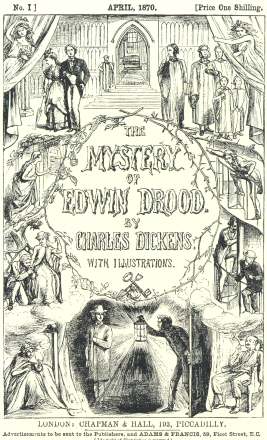
We now come to the evidence which Forster strangelyoverlooked, which Mr. Proctor and Mr. Archer correctlydeciphered, and which Mr. Cuming Walters misinterprets. OnDecember 22, 1869, Dickens wrote to Forster that two numbers ofhis romance were “now in type. Charles Collins hasdesigned an excellent cover.” Mr. C. A. Collins hadmarried a daughter of Dickens. [77] He was anartist, a great friend of Dickens, and author of that charmingbook, “A Cruise on Wheels.” His design of thepaper cover of the story (it appeared in monthly numbers)contained, as usual, sketches which give an inkling of the eventsin the tale. Mr. Collins was to have illustrated the book;but, finally, Mr. (now Sir) Luke Fildes undertook the task. Mr. Collins died in 1873. It appears that Forster neverasked him the meaning of his designs—a singularoversight.
The cover lies before the reader. In the left-hand topcorner appears an allegorical female figure of joy, withflowers. The central top space contains the front ofCloisterham Cathedral, or rather, the nave. To the leftwalks Edwin, with hyacinthine locks, and a thoroughly classicaltype of face, and Grecian nose. Like Datchery, hedoes not wear, but carries his hat; this meansnothing, if they are in the nave. He seems bored. Onhis arm is Rosa; sheseems bored; she trails her parasol,and looks away from Edwin, looks down, to her right. On thespectator’s right march the surpliced men and boys of theChoir. Behind them is Jasper, black whiskers and all; hestares after Edwin and Rosa; his right hand hides hismouth. In the corner above him is an allegorical female,clasping a stiletto.
Beneath Edwin and Rosa is, first, an allegorical femalefigure, looking at a placard, headed “LOST,” on adoor. Under that, again, is a girl in a garden-chair; ayoung man, whiskerless, with wavy hair, kneels and kisses herhand. She looks rather unimpassioned. I conceive theman to be Landless, taking leave of Rosa after urging hishopeless suit, for which Helena, we learn, “seems tocompassionate him.” He has avowed his passion, earlyin the story, to Crisparkle. Below, the opium hag issmoking. On the other side, under the figures of Jasper andthe Choir, the young man who kneels to the girl is seen boundingup a spiral staircase. His left hand is on the ironrailing; he stoops over it, looking down at others who followhim. His right hand, the index finger protruded, pointsupward, and, by chance or design, points straight at Jasper inthe vignette above. Beneath this man (clearly Landless)follows a tall man in a “bowler” hat, a“cut-away” coat, and trousers which show an inch ofwhite stocking above the low shoes. His profile is hid bythe wall of the spiral staircase: he might be Grewgious of theshoes, white stockings, and short trousers, but he may be Tartar:he takes two steps at a stride. Beneath him a youngish man,in a low, soft, clerical hat and a black pea-coat, ascends,looking downwards and backwards. This is clearlyCrisparkle. A Chinaman is smoking opium beneath.
In the central lowest space, a dark and whiskered man enters adark chamber; his left hand is on the lock of the door; in hisright he holds up a lantern. The light of the lanternreveals a young man in a soft hat of Tyrolese shape. Hisfeatures are purely classical, his nose is Grecian, his locks arelong (at least, according to the taste of to-day); he wears alight paletot, buttoned to the throat; his right arm hangs by hisside; his left hand is thrust into the breast of his coat. He calmly regards the dark man with the lantern. That man,of course, is Jasper. The young man is EDWIN DROOD, of theGrecian nose, hyacinthine locks, and classic features, as in SirL. Fildes’s third illustration.
Mr. Proctor correctly understood the unmistakable meaning ofthis last design, Jasper entering the vault—
“To-day the dead are living,
The lost is found to-day.”
Mr. Cuming Walters tells us that he did not examine thesedesigns by Mr. Collins till he had formed his theory, andfinished his book. “On the conclusion of the wholework the pictures were referred to for the first time, and werethen found to support in the most striking manner the opinionsarrived at,” namely, that Drood was killed, and that Helenais Datchery. Thus does theory blind us to facts!
Mr. Cuming Walters connects the figure of the whiskerlessyoung man kneeling to a girl in a garden seat, with the whiskeredJasper’s proposal to Rosa in a garden seat. ButJasper does not kneel to Rosa; he stands apart, leaning on asundial; he only once vaguely “touches” her, whichshe resents; he does not kneel; he does not kiss her hand (Rosa“took the kiss sedately,” like Maud in the poem);and—Jasper had lustrous thick black whiskers.
Again, the same whiskerless young man, bounding up the spiralstaircase in daylight, and wildly pointing upwards, is taken byMr. Cuming Walters to represent Jasper climbing the staircase toreconnoitre, at night, with a lantern, and, of course, with blackwhiskers. The two well-dressed men on the stairs(Grewgious, or Tartar, and Crisparkle) also, according to Mr.Cuming Walters, “relate to Jasper’s unaccountableexpedition with Durdles to the Cathedral.” Neither ofthem is Jasper; neither of them is Durdles, “in a suit ofcoarse flannel”—a disreputable jacket, as Sir L.Fildes depicts him—“with horn buttons,” and abattered old tall hat. These interpretations are quitedemonstrably erroneous and even impossible. Mr. Archerinterprets the designs exactly as I do.
As to the young man in the light of Jasper’s lamp, Mr.Cuming Walters says, “the large hat and thetightly-buttoned surtout must be observed; they are the articlesof clothing on which most stress is laid in the description ofDatchery. But the face is young.” The face ofDatchery was elderly, and he had a huge shock of white hair, awig. Datchery wore “a tightish blue surtout, with abuff waistcoat and grey trousers; he had something of a militaryair.” The young man in the vault has anything but amilitary air; he shows no waistcoat, and he does not wear“a tightish blue surtout,” or any surtout at all.
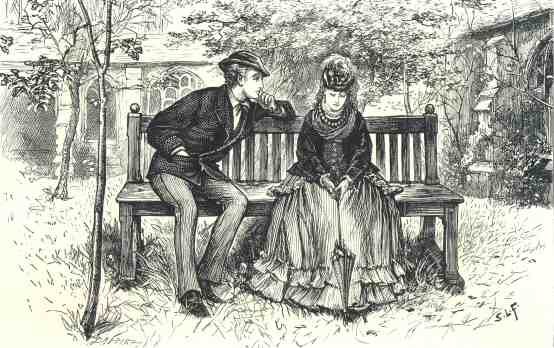
The surtout of the period is shown, worn by Jasper, in Sir L.Fildes’s sixth and ninth illustrations. It is afrock-coat; the collar descends far below the top of thewaistcoat (buff or otherwise), displaying that garment; the coatis tightly buttoned beneath, revealing the figure; the tails ofthe coat do not reach the knees of the wearer. The youngman in the vault, on the other hand, wears a loose paletot,buttoned to the throat (vaults are chilly places), and the coatfalls so as to cover the knees; at least, partially. Theyoung man is not, like Helena, “very dark, and fierce oflook, . . . of almost the gipsy type.” He is blonde,sedate, and of the classic type, as Drood was. He is nomore like Helena than Crisparkle is like Durdles. Mr.Cuming Walters says that Mr. Proctor was “unable to alludeto the prophetic picture by Collins.” As a fact, thispicture is fully described by Mr. Proctor, but Mr. Walters usedthe wrong edition of his book, unwittingly.
Mr. Proctor writes:—“Creeping down the cryptsteps, oppressed by growing horror and by terror of comingjudgment, sickening under fears engendered by the darkness ofnight and the charnel-house air he breathed, Jasper opens thedoor of the tomb and holds up his lantern, shuddering at thethought of what it may reveal to him.
“And what sees he? Is it the spirit of his victimthat stands there, ‘in his habit as he lived,’ hishand clasped on his breast, where the ring had been when he wasmurdered? What else can Jasper deem it? There,clearly visible in the gloom at the back of the tomb, standsEdwin Drood, with stern look fixed on him—pale, silent,relentless!”
Again, “On the title-page are given two of the smallpictures from the Love side of the cover, two from the Murderside, and the central picture below, which presents the centralhorror of the story—the end and aim of the ‘Datcheryassumption’ and of Mr. Grewgious’splans—showing Jasper driven to seek for the proofs of hiscrime amid the dust to which, as he thought, the flesh and bones,and the very clothes of his victim, had been reduced.”
There are only two possible choices; either Collins, underDickens’s oral instructions, depicted Jasper finding Droodalive in the vault, an incident which was to occur in the story;or Dickens bade Collins do this for the purpose of misleading hisreaders in an illegitimate manner; while the young man in thevault was really to be some person “made up” to looklike Drood, and so to frighten Jasper with a pseudo-ghost of thathero. The latter device, the misleading picture, would bechildish, and the pseudo-ghost, exactly like Drood, could not beacted by the gipsy-like, fierce Helena, or by any other person inthe romance.
Mr. Walters’s TheoryContinued
Mr. Cuming Walters guesses that Jasper was to aim a deadlyblow (with his left hand, to judge from the picture) at Helena,and that Neville “was to give his life forhers.” But, manifestly, Neville was to lead the huntof Jasper up the spiral stair, as in Collins’s design, andwas to be dashed from the roof: his body beneath was to be“that, I never saw before. Thatmust bereal. Look what a poor mean miserable thing it is!”as Jasper says in his vision.
Mr. Cuming Walters, pursuing his idea of Helena as bothDatchery and also as the owner of “the youngface” of the youth in the vault (and also of the younghands, a young girl’s hands could never pass for those of“an elderly buffer”), exclaims: “Imagine theintense power of the dramatic climax, when Datchery, the elderlyman, is re-transformed into Helena Landless, the young andhandsome woman; and when she reveals the seemingly impenetrablesecret which had been closed up in one guilty man’smind.”
The situations are startling, I admit, but how would CanonCrisparkle like them? He is, we know, to marry Helena,“the young person, my dear,” Miss Twinkleton wouldsay, “who for months lived alone, at inns, wearing a bluesurtout, a buff waistcoat, and grey—” Herehorror chokes the utterance of Miss Twinkleton. “Thenshe was in the vault in anotherdisguise, not morewomanly, at that awful scene when poor Mr. Jasper was driven mad,so that he confessed all sorts of nonsense, for, my dear, all theClose believes that it wasnonsense, and that Mr. Jasperwas reduced to insanity by persecution. And Mr. Crisparkle,with that elegant dainty mother of his—it has broken herheart—is marrying this half-caste gipsy trollop,with her blue surtout and grey—oh, it is a disgrace toCloisterham!”
The climax, in fact, as devised by Mr. Cuming Walters, israther too dramatic for the comfort of a minor canon. Ahumorist like Dickens ought to have seen the absurdity of thesituation. Mr. Walters maybe right, Helena may beDatchery, but she ought not to be.
Who was the Princess Puffer?
Who was the opium hag, the Princess Puffer? Mr. CumingWalters writes: “We make a guess, for Dickens gives us nosolid facts. But when we remember that not a word is saidthroughout the volume of Jasper’s antecedents, who he was,and where he came from; when we remember that but for his nephewhe was a lonely man; when we see that he was both criminal andartist; when we observe his own wheedling propensity, his falseand fulsome protestations of affection, his slyness, hissubtlety, his heartlessness, his tenacity; and when, above all,we know that the opium vice is hereditary, and that ayoungman would not be addicted to it unless born with thecraving; [91] then, it is not too wild a conjecturethat Jasper was the wayward progeny of this same opium-eatingwoman, all of whose characteristics he possessed, and, perchance,of a man of criminal instincts, but of a superior position. Jasper is a morbid and diseased being while still in thetwenties, a mixture of genius and vice. He hates and heloves fiercely, as if there were wild gipsy blood in hisveins. Though seemingly a model of decorum and devoted tohis art, he complains of his “daily drudging round”and “the cramped monotony of his existence.” Hecommits his crime with the ruthlessness of a beast, his ownnature being wholly untamed. If we deduce that his fatherwas an adventurer and a vagabond, we shall not be farwrong. If we deduce that his mother was the opium-eater,prematurely aged, who had transmitted her vicious propensity toher child, we shall almost certainly be right.”
Who was Jasper?
Who was Jasper? He was the brother-in-law of the lateMr. Drood, a respected engineer, and University man. We donot know whence came Mrs. Drood, Jasper’s sister, but is itlikely that her mother “drankheaven’s-hard”—so the hag says ofherself—then took to keeping an opium den, and thereentertained her son Jasper, already an accomplished vocalist, butin a lower station than that to which his musical genius laterraised him, as lay Precentor? If the Princess Puffer be, ason Mr. Cuming Walters’s theory she is, Edwin’slong-lost grandmother, her discovery would be unwelcome toEdwin. Probably she did not live much longer; “mylungs are like cabbage nets,” she says. Mr. CumingWalters goes on—
“Her purpose is left obscure. How easily, however,we see possibilities in a direction such as this. Thefather, perhaps a proud, handsome man, deserts the woman, andremoves the child. The woman hates both for scorning her,but the father dies, or disappears, and is beyond hervengeance. Then the child, victim to the ills in his blood,creeps back to the opium den, not knowing his mother, butimmediately recognized by her. She will make the childsuffer for the sins of the father, who had destroyed herhappiness. Such a theme was one which appealed toDickens. It must not, however, be urged; and the crucialquestion after all is concerned with the opium woman as one ofthe unconscious instruments of justice, aiding with her trifle ofcircumstantial evidence the Nemesis awaiting Jasper.
“Another hypothesis—following on the Carker themein ‘Dombey and Son’—is that Jasper, a dissoluteand degenerate man, lascivious, and heartless, may have wronged achild of the woman’s; but it is not likely that Dickenswould repeat the Mrs. Brown story.”
Jasper, père, father of John Jasper and of Mrs.Drood, however handsome, ought not to have deserted Mrs.Jasper. Whether John Jasper, prematurely devoted to opium,became Edwin’s guardian at about the age of fifteen, orwhether, on attaining his majority, he succeeded to some otherguardian, is not very obvious. In short, we cannot guesswhy the Princess Puffer hated Jasper, a paying client of longstanding. We are only certain that Jasper was a bad fellow,and that the Princess Puffer said, “I know him, better thanall the Reverend Parsons put together know him.” Onthe other hand, Edwin “seems to know” the opiumwoman, when he meets her on Christmas Eve, which may be a pointin favour of her being his long-lost grandmother.
Jasper was certainly tried and condemned; for Dickens intended“to take Mr. Fildes to a condemned cell in Maidstone, orsome other gaol, in order to make a drawing.” [96] Possibly Jasper managed to takehis own life, in the cell; possibly he was duly hanged.
Jasper, after all, was a failure as a murderer, even if wesuppose him to have strangled his nephew successfully. “It is obvious to the most excruciatingly feeblecapacity” that, if he meant to get rid of proofs of theidentity of Drood’s body by means of quicklime, it did notsuffice to remove Drood’s pin, watch, and chain. Drood would have coins of the realm in his pockets, gold, silver,bronze. Quicklime would not destroy these metallic objects,nor would it destroy keys, which would easily prove Drood’sidentity. If Jasper knew his business, he would, of course,rifle allof Edwin’s pockets minutely, and wouldremove the metallic buttons of his braces, which generallydisplay the maker’s name, or the tailor’s. Onresearch I find “H. Poole & Co., Savile Row” onmy buttons. In this inquiry of his, Jasper would havediscovered the ring in Edwin’s breast pocket, and wouldhave taken it away. Perhaps Dickens never thought of thatlittle fact: if he did think of it, no doubt he found some modeof accounting for Jasper’s unworkmanlike negligence. The trouser-buttons would have led any inquirer straight toEdwin’s tailor; I incline to suspect that neither Dickensnor Jasper noticed that circumstance. The conscientiousartist in crime cannot afford to neglect the humblest and mostobvious details.
CONCLUSION
According to my theory, whichmainly rests on the unmistakable evidence of the cover drawn byCollins under Dickens’s directions, all “endswell.” Jasper comes to the grief he deserves: Helena,after her period of mourning for Neville, marries Crisparkle:Rosa weds her mariner. Edwin, at twenty-one, is notheart-broken, but, a greatly improved character, takes, to quotehis own words, “a sensible interest in works of engineeringskill, especially when they are to change the whole condition ofan undeveloped country”—Egypt.
These conclusions are inevitable unless we either supposeDickens to have arranged a disappointment for his readers in thetableauof Jasper and Drood, in the vault, on the cover,or can persuade ourselves that not Drood, but some other youngman, is revealed by the light of Jasper’s lantern. Now, the young man is very like Drood, and very unlike the darkfierce Helena Landless: disguised as Drood, this time, not asDatchery. All the difficulty as to why Drood, if he escapedalive, did not at once openly denounce Jasper, is removed when weremember, as Mr. Archer and I have independently pointed out,that Drood, when attacked by Jasper, was (like Durdles in the“unaccountable expedition”) stupefied by drugs, andso had no valid evidence against his uncle. Whether scienceis acquainted with the drugs necessary for such purposes isanother question. They are always kept in stock by starvingand venal apothecaries in fiction and the drama, and are arecognized convention of romance.
So ends our unfolding of the Mystery of Edwin Drood.
THE END
PRINTED BYWILLIAM CLOWES AND SON, LIMITED, LONDON AND BECCLES.
FOOTNOTES
[11] Landless is not“Lackland,” but a form of de Laundeles, a Lothianname of the twelfth century, merged later in that ofOrmistoun.
[48] Life of Dickens, vol. iii.pp. 425–439.
[74] J. Cuming Walters, p. 102;Proctor, pp. 131–135. Mr. Cuming Walters used anedition of 1896, apparently a reprint of a paper by Proctor,written earlier than his final book of 1887. Hence theerror as to Mr. Proctor’s last theory.
[77] Mrs. Perugini, the books say, butcertainly a daughter.
[91] What would Weissmann say to allthis?
[96] So Mr. Cuming Walters quotes Mr.Hughes, who quotes Sir L. Fildes. Hebelieves thatJasper strangled Edwin with the black-silk scarf, and, no doubt,Jasper was for long of that opinion himself.
(Editor: Badge Kits)
 The Project Gutenberg eBook of A Horse's Tale, by Mark Twain
 Evergreens, by Jerome K. Jerome
 Tanglewood Tales by Nathaniel Hawthorne,
 Her Father’s Daughter
 Domestic Peace, by Honore de Balzac
- The God of His Fathers
- The Soul of Man, by Oscar Wilde
- Memoirs of Carwin the Biloquist, by Charles Brockden Brown
- Sunday under Three Heads, by Charles Dickens
- The Project Gutenberg eBook of Coriolanus, by William Shakespeare
- The Confutatio Pontificia, by Anonymous
- A Hero of Our Time, by J. H. Wisdom and Marr Murray
- The Merry Adventures of Robin Hood, by Howard Pyle
-
A Drama on the Seashore, by Honore de Balzac
 A DRAMA ON THE SEASHORE By Honore De Balzac Translated By Katharine Prescott Wormeley DEDIC
...[Details]
A DRAMA ON THE SEASHORE By Honore De Balzac Translated By Katharine Prescott Wormeley DEDIC
...[Details]
-
The Adventures of Col. Daniel Boon, by John Filson
 THE ADVENTURES OF COL. DANIEL BOON CONTAINING A NARRATIVE OF THE WARS OF KENTUCKE From The Dis
...[Details]
THE ADVENTURES OF COL. DANIEL BOON CONTAINING A NARRATIVE OF THE WARS OF KENTUCKE From The Dis
...[Details]
-
The Project Gutenberg eBook of Ethics — Part 3, by Benedictus de Spinoza
 Produced by an anonymous Project Gutenberg volunteer.Benedict de Spinoza, THE ETHICS(Ethica Ordine G
...[Details]
Produced by an anonymous Project Gutenberg volunteer.Benedict de Spinoza, THE ETHICS(Ethica Ordine G
...[Details]
-
The Project Gutenberg eBook of La Divina Commedia di Dante: Paradiso, by Dante Alighieri
 LA DIVINA COMMEDIAdi Dante AlighieriCANTICA III: PARADISOContentsPARADISOCanto I. Canto II. Canto II
...[Details]
LA DIVINA COMMEDIAdi Dante AlighieriCANTICA III: PARADISOContentsPARADISOCanto I. Canto II. Canto II
...[Details]
-
Tartarin of Tarascon, by Alphonse Daudet
 TARTARIN OF TARASCON By Alphonse Daudet Contents EPISODE THE FIRST, IN TARASCON EPISODE THE
...[Details]
TARTARIN OF TARASCON By Alphonse Daudet Contents EPISODE THE FIRST, IN TARASCON EPISODE THE
...[Details]
-
Tour through the Eastern Counties of England, 1722, by Daniel Defoe
 Transcribed from the 1891 Cassell & Company edition byDavid Price, email [email protected]
...[Details]
Transcribed from the 1891 Cassell & Company edition byDavid Price, email [email protected]
...[Details]
-
The Jew of Malta, by Christopher Marlowe
 THE JEW OF MALTA. By Christopher Marlowe Edited By The Rev. Alexander Dyce The Famous Trage
...[Details]
THE JEW OF MALTA. By Christopher Marlowe Edited By The Rev. Alexander Dyce The Famous Trage
...[Details]
-
 A WOMAN OFNO IMPORTANCEA PLAYBYOSCAR WILDE METHUEN & CO., LTD.36 ESSEX STREET W.C.LONDONEighth E
...[Details]
A WOMAN OFNO IMPORTANCEA PLAYBYOSCAR WILDE METHUEN & CO., LTD.36 ESSEX STREET W.C.LONDONEighth E
...[Details]
-
The Project Gutenberg eBook of Cratylus, by Plato
 CRATYLUSBy PlatoTranslated by Benjamin JowettContentsINTRODUCTIONCRATYLUSINTRODUCTIONThe Cratylus ha
...[Details]
CRATYLUSBy PlatoTranslated by Benjamin JowettContentsINTRODUCTIONCRATYLUSINTRODUCTIONThe Cratylus ha
...[Details]
-
Narrative of the Captivity and Restoration Of Mrs. Mary Rowlandson, by Mrs. Mary Rowlandson
 NARRATIVE OF THE CAPTIVITY AND RESTORATION OF MRS. MARY ROWLANDSON By Mrs. Mary Rowlandson CON
...[Details]
NARRATIVE OF THE CAPTIVITY AND RESTORATION OF MRS. MARY ROWLANDSON By Mrs. Mary Rowlandson CON
...[Details]
- Give Me Liberty Or Give Me Death
- Lincoln's Gettysburg Address
- The United States' Constitution
- The United States Bill of Rights
- Alice’s Adventures in Wonderland
- The Declaration of Independence of the United States of America
- Lincoln’s Second Inaugural Address, March 4, 1865.
- Lincoln’s First Inaugural Address
- Through the Looking
- The Hunting of The Snark


- The Life of Christopher Columbus, by Edward Everett Hale,
- The Project Gutenberg eBook of The Diary of a Nobody, by George and Weedon Grossmith
- The Project Gutenberg eBook of The Real Cyberpunk Fakebook, by St. Jude et al.
- A House of Pomegranates, by Oscar Wilde
- The Project Gutenberg eBook of Ethics — Part 3, by Benedictus de Spinoza
- The Merry Adventures of Robin Hood, by Howard Pyle
- Evergreens, by Jerome K. Jerome